
Manufacturing Website Optimization: From Factory Floor to First Click How to Win More B2B Customers


Introduction
A manufacturing website has to do more than display products, machinery and company information. It needs to help potential buyers understand what you manufacture, why your capabilities matter and how they can take the next step. This is where manufacturing website optimization becomes important.
For B2B manufacturers, the buying journey often starts long before a sales conversation. A procurement manager may search for a supplier, compare capabilities, review technical information and assess credibility before submitting an enquiry. If the website is slow, difficult to navigate or unclear about its offerings, a valuable opportunity can disappear.
SigntoDesign Pvt Ltd., approaches website improvement from both the user's and search engine's perspective. The goal is not simply to make a website look modern, but to make it easier to discover, understand and use.
This article explores practical ways manufacturers can improve their websites, strengthen their online visibility and turn more website visitors into qualified B2B enquiries.
Table of Contents
|
Why Manufacturing Websites Need Optimization
Manufacturing website optimization is the process of improving a manufacturing website's structure, content, performance, usability and search visibility so that it better serves both buyers and search engines.
A manufacturing website often has a very different audience from a consumer website. Visitors may include engineers, procurement teams, distributors, OEMs and business owners. They are usually looking for specific information rather than browsing casually.
A well-optimized website should make it easy to:
Understand the company's core capabilities.
Find relevant products or services.
Review specifications and applications.
Assess experience and credibility.
Request a quotation or contact the sales team.
Google also recommends creating websites that help users find and understand content while making it easier for search engines to crawl and interpret pages.
Improve the B2B Buyer Experience
A strong manufacturing website user experience begins with one simple question: Can the right buyer quickly find the information they need?
If the answer is no, visual improvements alone will not solve the problem.
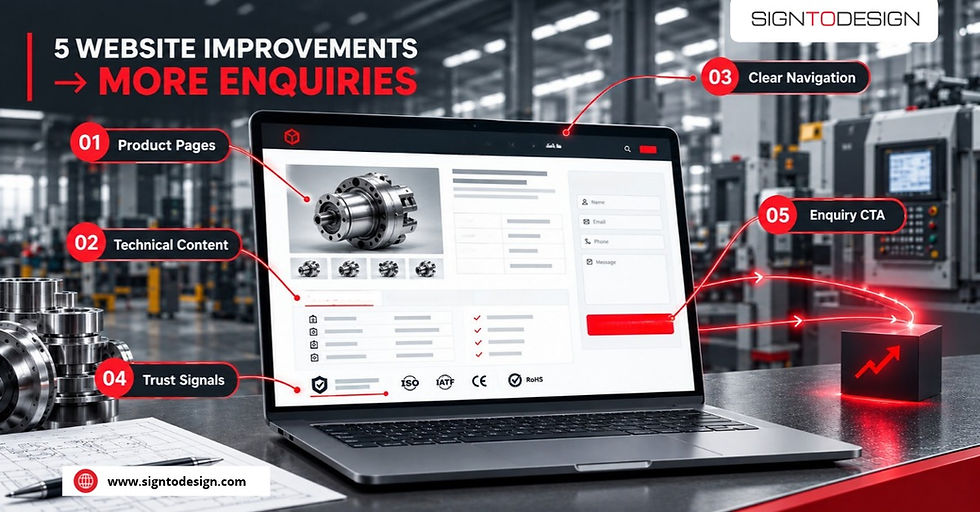
1. Simplify navigation
Organise the main menu around the way customers search for information. Useful sections may include:
Products
Manufacturing capabilities
Industries served
Applications
About the company
Resources
Contact or Request a Quote
Avoid hiding important information behind several layers of navigation.
2. Make technical information accessible
Engineers and procurement teams may need dimensions, materials, tolerances, certifications, production capacity or application details. Put this information on relevant product and service pages instead of making visitors request every basic detail.
3. Design for mobile users
Manufacturing websites are frequently viewed on mobile devices during research, meetings and supplier comparisons. Pages should remain easy to read and navigate across different screen sizes.
Google's guidance also stresses the importance of good user experience, site security, performance and mobile considerations.
Build a Website Structure Around Manufacturing Capabilities
One of the most useful principles in website optimization for manufacturers is to structure content around buyer intent.
A company may manufacture dozens of products, but buyers may search by application, material, process, industry or capability.
For example, instead of creating one generic “Services” page, a manufacturer could create focused pages for:
CNC machining
Sheet metal fabrication
Injection moulding
Precision engineering
Contract manufacturing
Custom components
These pages can explain the process, applications, industries served, materials, equipment and quality standards.
This approach also creates more opportunities for SEO for manufacturing companies, because individual pages can target specific search queries instead of forcing every service onto one crowded page.
Create content around real customer questions
Consider questions such as:
What materials can you work with?
What industries do you serve?
What production volumes do you support?
Do you provide custom manufacturing?
What quality certifications do you hold?
What is the typical RFQ process?
Answering these questions directly can improve usability while creating useful search-focused content.
Strengthen SEO and Technical Performance
Good manufacturing website optimization is not only about keywords. Technical performance and content quality matter too.
Focus on these areas
Page speed: Compress large images and remove unnecessary scripts or plugins.
Technical SEO: Make sure important pages can be crawled and indexed.
Page titles and headings: Use descriptive titles that accurately represent each page.
Internal links: Connect related products, capabilities, industries and resources.
Image optimization: Use descriptive file names and meaningful alt text.
HTTPS: Keep the website secure and properly configured.
Core Web Vitals: Monitor loading performance, responsiveness and visual stability.
Google recommends monitoring technical requirements, indexing and search performance through tools such as Search Console.
Comparison: Basic vs Optimized Manufacturing Website
Feature | Basic Website | Optimized Website |
Navigation | Generic menu | Buyer-focused structure |
Product information | Limited | Detailed specifications |
SEO | Broad keywords | Intent-focused pages |
Mobile experience | Basic adaptation | Mobile-first usability |
Lead generation | Generic contact form | Clear enquiry/RFQ paths |
Content | Company-focused | Buyer-focused |
Performance | Unmonitored | Regularly tested |
Turn Website Visitors into Qualified Leads
Traffic alone does not create business. A successful manufacturing website should guide relevant visitors towards a useful action.
This is where manufacturing website user experience and conversion optimization work together.
Consider adding:
“Request a Quote” button.
Product-specific enquiry forms.
Downloadable brochures or specifications.
Clear telephone and email options.
Case studies.
Certifications and quality information.
Strong calls to action on product and capability pages.
Keep enquiry forms practical. Asking for too much information can discourage prospects, while asking for too little may make the enquiry difficult for the sales team to qualify.
Pro Tip Place a relevant call to action close to the information that creates buying intent. For example, a CNC machining page could end with “Discuss Your CNC Machining Requirement” rather than using the same generic “Contact Us” button everywhere |
Build Trust Through Useful Content
Manufacturing buyers need confidence before starting a commercial conversation. A polished website helps, but evidence is more persuasive than design alone.
Useful trust-building content includes:
Customer case studies.
Certifications and compliance information.
Quality-control processes.
Manufacturing equipment.
Production capabilities.
Industry experience.
Project examples.
Technical articles.
Frequently asked questions.
SigntoDesign Pvt Ltd., can use this type of content strategy to help manufacturers communicate expertise without turning every page into a sales pitch.
Content should demonstrate actual knowledge of manufacturing processes and customer requirements. Avoid generic articles that could apply to any business.
For example, a manufacturer of precision components could publish an article explaining material selection, tolerance considerations or common production challenges. This gives engineers and procurement professionals useful information while establishing subject-matter credibility.
A Practical Manufacturing Website Optimization Checklist
Before launching a redesigned or improved website, review the following:
Navigation clearly reflects products, services and capabilities.
Every major product or service has a dedicated page.
Technical specifications are easy to find.
Website pages work well on mobile devices.
Images are compressed and properly described.
Page titles and headings are descriptive.
Important pages can be crawled and indexed.
Internal links connect related content.
Calls to action are visible and relevant.
Contact and RFQ forms are easy to complete.
Certifications and quality information are accessible.
Website performance is monitored regularly.
Search performance is reviewed using analytics and Search Console.
Make the Website Part of the Sales Process
The strongest website optimization for manufacturers connects marketing activity with the sales process.
For example, someone may discover a company through a Google search for a particular manufacturing process. They then visit a capability page, review an application example, check certifications and submit an RFQ.
That journey should feel natural.
The website should answer enough questions to help a prospect move from “Can this company do what I need?” to “I should speak to this company.”
This is also why SEO for manufacturing companies should not be treated as a separate activity from website development. Search visibility, content, UX and conversion paths all contribute to the same customer journey.
Google's current guidance emphasises helpful, people-first content and makes pages easy for search engines to understand.
Frequently Asked Questions
What is manufacturing website optimization?
Manufacturing website optimization is the process of improving a manufacturer's website so it is easier to find, navigate and use. It covers SEO, technical performance, content, mobile usability, website structure, conversion paths and buyer-focused information.
Why is website optimization important for manufacturers?
Manufacturers often serve specialised B2B audiences that need detailed information before making contact. A well-optimized website helps buyers find relevant capabilities, understand products and services, evaluate credibility and submit enquiries with less friction.
How can a manufacturing website generate more B2B leads?
A manufacturing website can generate more B2B leads by creating focused product and capability pages, improving search visibility, adding clear calls to action, simplifying RFQ forms and publishing useful technical content. Strong case studies, certifications and application information can also help build buyer confidence.
What should a manufacturing website include?
A manufacturing website should typically include products or services, manufacturing capabilities, industries served, applications, technical specifications, certifications, case studies, company information, contact details and clear enquiry or RFQ options. The exact structure should reflect how the company's target buyers research suppliers.
Does SEO help manufacturing companies attract customers?
Yes. SEO for manufacturing companies can help relevant buyers discover products, services and capabilities through organic search. Results depend on factors such as search demand, competition, technical quality, content relevance and authority. SEO should therefore be treated as an ongoing process rather than a one-time website task.
How often should a manufacturing website be improved?
There is no fixed schedule for website improvements. Manufacturers should review website performance, search visibility, user behaviour and lead quality regularly. Larger updates may be needed when products, capabilities or markets change, while technical SEO, security and performance should be monitored continuously.
Conclusion
A manufacturing website should be more than a digital company brochure. It should help the right buyers discover your capabilities, understand your value and take the next step towards a business conversation.
Effective manufacturing website optimization brings together user experience, technical SEO, useful content, performance and conversion-focused design. When these elements work together, the website becomes a stronger part of the B2B sales journey.
For manufacturers, the priority should be simple: make important information easier to find, make technical content easier to understand and make enquiries easier to start.
SigntoDesign Pvt Ltd., can help businesses evaluate where their existing website is losing opportunities and identify practical improvements across design, content, SEO and user experience.
If your manufacturing website is not generating the visibility or enquiries you expect, now is a good time to review its structure and performance. Contact SigntoDesign Pvt Ltd., to discuss how your website can be improved to better support your B2B marketing and sales goals.


Comments