
How Manufacturers Should Showcase Factory Infrastructure on Their Website
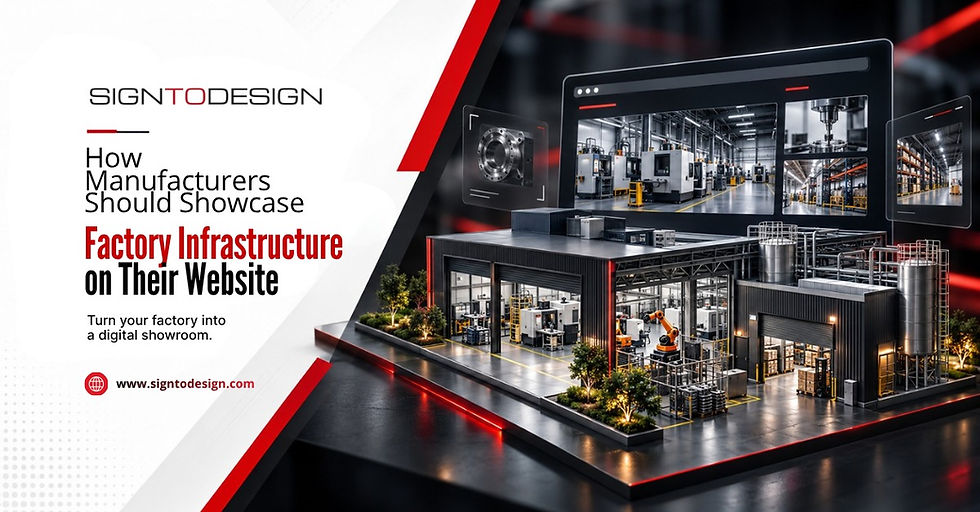
When a procurement manager, OEM buyer or export distributor shortlists a supplier, they rarely visit the factory first they visit the website. How you showcase factory infrastructure can influence whether that buyer sends an RFQ or quietly moves on.
The problem is that many manufacturing websites describe their facilities instead of actually showing them. Terms like “world-class,” “state-of-the-art” and “modern” have become so common that they offer little proof of real capability. Buyers want to see the machinery, production areas, quality systems and facilities that support your claims. This article explains a practical approach to showcase factory infrastructure in a way that builds genuine buyer confidence.
Why Visual Evidence Matters to Buyers
Procurement teams and OEM buyers are trained to reduce supplier risk. They want to know, before they commit to a purchase order, that your facility is real, capable and organised. A well-presented factory section on your website does the same job as a factory audit visit, at least at the shortlisting stage. It answers the questions a buyer would ask if they walked through your door.
The goal is not photography for its own sake. The goal is to give a buyer enough specific, verifiable visual evidence that they feel confident putting you on a shortlist.
How to Showcase Factory Infrastructure Effectively
Generic facility photographs taken from a distance add little value. What buyers respond to is specific, labelled content that maps directly to their evaluation criteria.
Machinery and production equipment. Photograph individual machines and label each one with the make, model, capacity and any relevant specification. A buyer sourcing precision-turned components wants to see your CNC lathe with its turning diameter and bar capacity, not a wide-angle shot of a busy shop floor.
Production floor layout. A simple annotated floor plan or a sequence of photographs showing material flow from raw material receipt through to finished goods helps buyers understand your process discipline and capacity. This is particularly useful for EPC contractors and OEM buyers who need to assess whether your layout supports the volumes they require.
Quality laboratory and inspection equipment. Show your measurement and testing equipment. Include the name of the instrument, its range and, where visible, a calibration tag or sticker. This signals to a quality-conscious buyer that your inspection process is systematic rather than informal.
Certifications displayed in context. Rather than placing a flat certificate logo on your homepage, photograph the actual framed certificate on the wall of your quality room or reception. Include the certifying body, the scope and the validity date. This is more credible than a generic badge because it is harder to fake.
People with names and roles. A photograph of your quality manager at the inspection bench, or your production supervisor on the floor, with their name and designation beneath, builds more trust than a stock photograph of anonymous workers in hard hats. Buyers want to know there are accountable people behind the processes.
Dispatch and warehousing area. Photographs of a clean, organised dispatch area with finished goods properly packed and labelled tell a buyer that you manage the end of your process as carefully as the beginning. For export buyers especially, this signals that your documentation and packaging practices are in order.
Practical Guidance on Presentation
Use descriptive captions, not decorative ones. Every photograph should carry a caption that states what the buyer is looking at and why it is relevant. For example: Okuma LB3000 CNC turning centre, turning diameter 300 mm, used for shaft and sleeve components in the 50 to 300 mm range.
Organise by buyer question, not by department. A buyer does not think in terms of your internal departments. They think in terms of: Can this supplier make my part? Can they hold the tolerance? Can they inspect it properly? Can they deliver on time? Structure your factory section to answer those questions in sequence.
Keep image quality consistent. Mixed quality photographs, some taken on a smartphone in poor light and some taken professionally, undermine the credibility of the page. Invest in one good photography session and use those images consistently across the website.
Update the content when your capability changes. If you add a machine, obtain a new certification or expand your floor space, update the website promptly. A facility page that lists equipment you no longer operate, or omits equipment you have recently added, is a liability.
What Buyers Notice When It Is Missing
When a manufacturing website has no facility photographs, no equipment list and no quality system evidence, buyers draw their own conclusions. They assume the facility is either too small to photograph credibly, or that the company does not understand what buyers need to see. Either conclusion costs you enquiries.
The absence of factory content is not neutral. It is a signal.
A Note on Video
A short, well-edited factory walkthrough video of two to four minutes can be a powerful complement to photographs and written content. It does not need to be produced expensively. What matters is that it is steady, well-lit, clearly narrated and focused on the specific capabilities a buyer would want to evaluate. If you have the resource to produce one, place it prominently on your facilities page and link to it from your capabilities section.
The Broader Point
Your website is, for most buyers, the first factory visit they make. The manufacturers who understand this and invest in presenting their infrastructure clearly and specifically will consistently outperform those who rely on adjectives and generic claims.
Credibility is built from evidence. Evidence on a manufacturing website is visual, specific and organised around the questions buyers actually ask.
If you want to understand how your current website performs against what procurement and OEM buyers look for, the Website Growth for Manufacturing Companies service from SignToDesign is designed specifically for this.


Comments